 Albania Economia
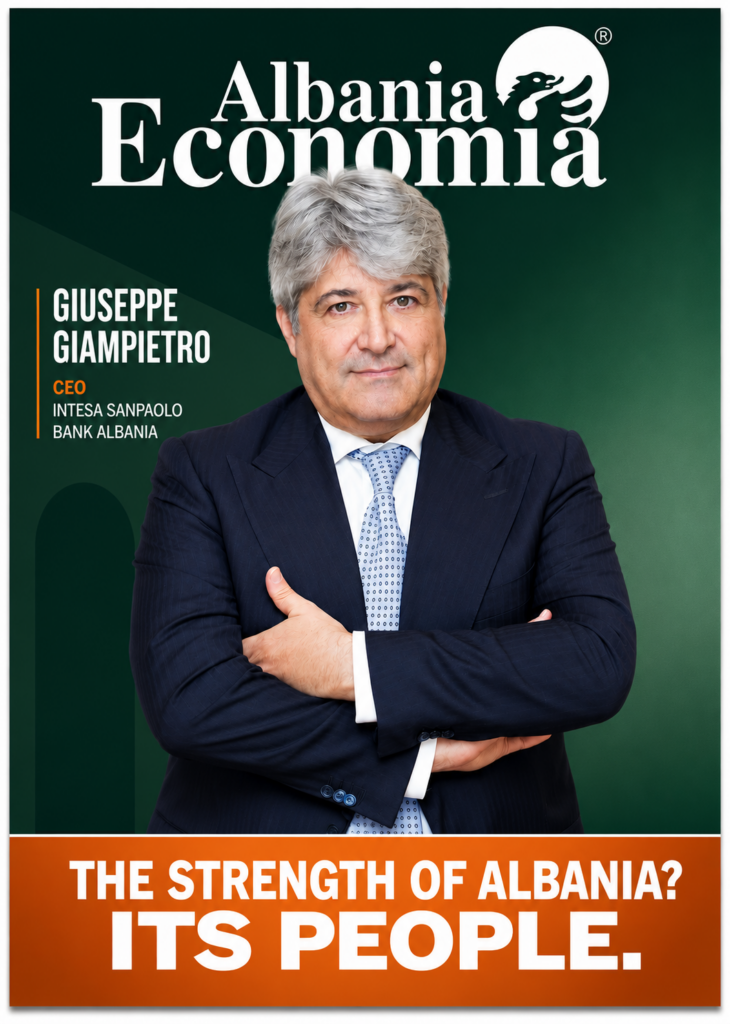
Arriving in Albania after more than twenty-five years of international experience within the Intesa Sanpaolo Group, the CEO of Intesa Sanpaolo Bank Albania shares with Albania Economia Magazine his vision of the country’s future, the role of younger generations, and the transformations reshaping both the banking sector and the wider business landscape.
You have been in Albania for only a few months. What are your first impressions of the country, particularly from an economic perspective?
My first encounter with Albania dates back many years, almost by chance. It was the early 1990s, and during a sailing trip with my uncle, a technical issue forced us to stop along the Albanian coast. I still have a very vivid image from that time: what looked like a “forest of satellite dishes” pointing towards Italy, used to capture Italian television signals. It was the symbol of a country looking towards Europe and eager to open to the world.
I returned to Tirana only a few months ago, this time by plane and with a completely different perspective. I found a city in full momentum. The first thing that strikes you is the cranes: so many cranes. The numerous construction cranes shaping the skyline of the capital tell a story of growth and transformation that many European countries are no longer accustomed to seeing.
But what impressed me most is the entrepreneurial energy. I have met many business owners who are serious, skilled, and driven by remarkable enthusiasm. At the same time, like many countries across Europe, Albania faces the challenge of attracting, developing, and retaining talent.
Another aspect that deeply struck me was walking through Skanderbeg Square and reflecting on the remarkable coexistence of different religious communities in the heart of the capital. At a time when the world often appears divided, Albania offers a concrete example of dialogue, mutual respect, and coexistence that deserves recognition.
The Albanian government aims for EU membership by 2030. How can the banking sector act as a catalyst for aligning Albanian regulatory standards with those of the European Union?
Before discussing Albania’s accession to the European Union, it is important to reflect on what Europe represents. Europe is, above all, a shared space of opportunities: the ability to study, work, invest, and build one’s future within a framework of common values and standards. From this perspective, Albania is already closely connected to Europe through its economic relationships, cultural ties, entrepreneurial initiatives, and the aspirations of its people. Formal accession would represent an important milestone in a journey that is already well underway. The banking system plays a fundamental role in this process, as it is one of the key drivers of economic and regulatory integration. We have already seen this with the introduction of SEPA mechanisms, which have delivered tangible benefits for citizens and businesses, by simplifying payments and reducing the cost of cross-border transactions. The European integration process offers important opportunities for growth, competitiveness, and investment, while strengthening the connections between Albania and its European partners. We believe the banking sector can play a significant role in supporting this journey through innovation, regulatory alignment, financial inclusion, and the adoption of international best practices.
The opening of accession negotiations increases investor confidence. Which key sectors of the Albanian economy do you see as most promising ahead of EU integration?
Albania has numerous strengths, and I believe the coming years could bring significant growth across several sectors. Tourism continues to hold enormous development potential, supported by the country’s natural beauty, cultural heritage, and growing international visibility. I also see strong opportunities in the energy sector, particularly in renewables. Albania has a solid tradition in clean energy production and could further strengthen its position as a regional benchmark in the energy transition. Another particularly promising area is technology and innovation. Digital transformation is rapidly reshaping business models across industries, and Albania has a young, dynamic population with increasingly competitive skills. As a bank, we also closely observe the strong economic link between Albania and Italy. A significant figure concerns the Albanian community living in Italy. Through the Intesa Sanpaolo Group, we serve around 100,000 Albanian clients (as of the end of 2025) residing in Italy who maintain economic, family, and financial ties with their home country. We are increasingly working to develop integrated services between the two countries and to support this community in its investment, entrepreneurial, and personal financial projects.
The bank has recently been awarded Best ESG Bank Albania 2026. What concrete sustainable finance projects are you implementing for Albanian businesses?
When discussing ESG, the focus is often placed exclusively on the environmental component, but the concept is much broader and includes social and governance aspects. On the environmental side, we are strongly supporting investments in renewable energy. The results achieved in solar and wind projects are particularly encouraging and confirm the country’s strong potential. We have also developed dedicated financing conditions for certified buildings and investments that meet high sustainability standards. At the same time, we invest heavily in the social dimension of ESG. We promote internal training programs on inclusion, respect for diversity, gender equality, and responsible behavior within the organization. Strong governance practices and transparency are equally important elements of our approach. Albania already has a natural green vocation, and our goal is to support businesses and families in a sustainable growth path that creates long-term value. The recognition as Best ESG Bank Albania by the Global Banking & Finance Awards and the confirmation as Top Employer in Albania by the Top Employers Institute are not only a source of pride, but also a confirmation that we are moving in the right direction.
Intesa Sanpaolo Bank Albania has been confirmed as Top Employer 2026. How are you addressing talent retention and attracting local talent, a key issue for the country’s future?
The ability to attract and retain talent is one of the most important challenges not only for the banking sector but for the entire Albanian economy. Many young Albanians seek to gain valuable international experience abroad. The challenge is to continue creating opportunities that encourage them to see Albania as an attractive place to build their long-term careers and contribute to the country’s development. As a Group, we are strongly investing in people, continuous training, and professional development. The “Top Employer” recognition reflects our commitment to building an inclusive, merit-based, and growth-oriented working environment. The transformation of the banking sector also requires new skills. Our Group vision is to combine the strengths of a leading banking institution with agility, innovation, and digital capabilities typically associated with technology-driven organizations. This means rethinking processes, operating models, and competencies, while valuing the contribution of younger generations who often bring different languages, mindsets, and approaches compared to the past. It is precisely the combination of experience and new skills that generates the best ideas. We are progressively introducing new technologies and artificial intelligence tools to simplify processes, improve efficiency, and offer faster and more personalized services to clients. On this journey, intergenerational dialogue is a key driver of innovation. I believe Albania’s future will also depend on its ability to enhance its human capital, offering young people stimulating professional opportunities and the chance to contribute directly to the country’s development.
You bring more than 25 years of international experience within the Group. What is the most important lesson you have learned across the different markets you have worked in?
There is an example I often use. In Italy, spaghetti is a traditional dish. In many other countries, it is considered an exotic dish. This simple observation reminds us how important it is not to look at reality only from our own perspective. The most important lesson I have learned from working across different markets is the importance of listening. One must remain curious, open-minded, and willing to constantly challenge oneself. Those who believe they already know everything risk being left behind. We live in an economic environment that is changing at an unprecedented speed. Take credit analysis, for example: today it is no longer sufficient to look at a company’s historical financial data. Businesses can change radically in a very short time, as can the markets in which they operate. This requires new tools, interpretative skills, and a strong ability to adapt. I chose to move to Albania with my family precisely because I believe that to truly understand a country, one must live it, listen to it, and share its daily life. It is this closeness that makes it possible to contribute meaningfully to its growth and to support the ambitions of its people and businesses.