 Albania Economia
We meet the Founder and CEO of Interlogica, a company with a high level of technological expertise based on an Ethic-Hacker philosophy and a strong belief in the value of people and relationships.
A hacker culture, selling projects rather than products, placing people at the center… but what does Interlogica actually do?
I will answer starting from people. Our Ethic Hacker background has allowed us over time to attract talents aligned with a very flexible mindset, capable of “seeing” where others do not, across all areas of our ecosystem. The company has in fact grown around people with very diverse skills, backgrounds and expertise, all sharing a lateral approach to situations and problems. The core business of Interlogica revolves around the “building” of digital platforms developed through the use of a wide range of technologies, including cutting-edge ones. We build highly strategic and tailored solutions, and this is precisely because we are a “toolbox” of diverse competencies. Our strength lies in delivering bespoke projects, with no off-the-shelf products. This clearly puts us in a strong competitive position, giving us the freedom to find the best solution for our clients. Working with digital strategies and advanced software is fertile ground for us to develop a humanistic culture that truly puts people at the center. And I mean it. Our structure is horizontal, which is already a competitive advantage in itself, and it provides everyone with the tools to grow and use creativity to do what they love, while at the same time creating value for clients. Interlogica is, in short, an innovative ecosystem of passionate people who, through strategy, consulting and software, create sustainable futures for other human beings.
Automotive, Cyber Security, Energy, Fintech. These are some of the fields in which you operate. Let’s explore together the Interlogica universe.
We have never set limits or boundaries when it comes to potential business areas or sectors. In practice, we operate wherever technology is involved, and honestly I cannot currently imagine any human activity where it is not present. We are particularly strong in certain sectors, such as Automotive, where we develop solutions for long-term vehicle leasing fleet management. I can say that around 80% of vehicles in that market in Italy reach the road thanks also to software developed by us. Going into more detail, we also work extensively in the Energy sector, where large data repositories (Big Data) allow us to successfully apply Data Science approaches and use Artificial Intelligence technologies in projects. In Healthcare, we have developed AI systems for Quality Assurance applied to pharmaceutical production lines. More recently, we have been involved in Digital Healthcare projects supporting patients and healthcare staff through the development of “Digital Twins” and other sector-specific tools. We also operate in the Fintech space as software platform developers for the industrialization of credit recovery and treasury processes. In addition, through specialized startups, we are co-founders of MyCreditService, which operates in the Invoice Management sector. Last, but certainly not least, is Cybersecurity, deeply rooted in our DNA. This area holds a particularly important position in our company, as it is part of the expertise we bring to every platform we work on. It is no coincidence that our internal Cybersecurity team has a very high level of specialization. Through this unit, we support SMEs both in Italy and abroad in the field of security. First of all, we train people working in companies to be aware, explaining the risks they may face and presenting tools to defend against cyber attacks. We also carry out direct Pen Testing activities—tests in which we simulate, in agreement with the client, real cyberattacks to evaluate the effectiveness of the organization’s defenses.

You base your company on humanistic entrepreneurship. What does that mean?
It means building a company based on the deep awareness that, whatever market you operate in, human intelligence is the highest form of expression and competitiveness. It is precisely this focus on intelligence that becomes the epicenter of a radical transformation in the way we conceive the company and its organization: the recognition that every human being should be able to express themselves at their best and focus on fulfilling higher-level needs—referring to psychological needs and self-actualization, as described in Maslow’s well-known hierarchy of needs. In simple terms, we work to create work ecosystems designed to encourage the natural emergence of each person’s skills, laying the foundations for internal evolution and growth based on individual inclinations, rather than hierarchical advancement. Ours is an agile organizational culture in which people work collaboratively in multidisciplinary teams within a context that allows experimentation and mistakes without “punishment”—because mistakes are part of learning. This creates an environment of psychological safety that supports individual growth and, consequently, the growth of the entire organization. This approach encourages everyone’s contribution to continuous change, increasingly forming a kind of collective intelligence detached from the “command and control” logic inherited from the industrial economy—an approach we believe is no longer suited to the era we live in.
Today, how difficult is it to do business with this vision?
I would say there are two aspects that require attention. The first concerns the new people who join the organization. In professional terms, most of us have been trained in non-humanistic companies, so understanding and fully adopting a different culture requires a certain amount of time. I would also underline that, once people become accustomed to this kind of environment, they may find it difficult to go back to working in hierarchical companies. The second aspect concerns interaction with our stakeholders. We often experience a mismatch between our approach—built to operate in innovation-driven environments within a constantly changing market—and the organizational culture of some clients, which is still anchored in project management processes that are no longer suited to the speed of evolution of our world. Being responsive has taught us to live with this type of situation, and we have quickly learned to make these two models coexist. Sometimes, even our clients, over time, begin to approach innovative projects in a more agile way, and this gives us great satisfaction.
You use a revolutionary method for assigning company bonuses to your employees. What does it involve?
The topic of company bonuses is very important and delicate in an organization like ours. We started from the assumption that no tool is capable of “motivating” a human being, just as no monetary “reward” can improve creativity or intelligence. On the other hand, we are aware of the importance of salary in meeting people’s basic needs and helping them focus on what they are most passionate about. For this reason, we decided to work on several fronts. Instead of rewarding the action of “doing one’s job well”—which, by definition, is why we work and not something to be additionally rewarded—we focused on rewarding what we believe is essential for organizational development: collaboration. Based on this idea, we developed a web app called Big UP!. Each Interlogico/a is given a fixed number of tokens every month to give to colleagues, accompanied by a message explaining the reason. The tokens received accumulate in a personal wallet. Periodically, the company allows them to be converted into “benefits” (days off, money, welfare, and similar perks). In this way, collaboration is transformed into value, for both the giver and the receiver. Another approach is more complex and we are still working on it at Interlogica. It is based on the idea that those who contribute to generating value should share in it. In practice, it is a mathematical model designed to distribute to each Interlogico/a who participated in a project a portion of its margin, as an extra bonus on top of their salary.
Is it possible to measure the satisfaction of your employees? And how much does your approach affect their work-life quality?
Growth and continuous change define us, but throughout the journey we always keep the focus on people’s well-being. We use several tools for this purpose. One of them is People Radar, a questionnaire sent annually to all Interlogicians to gauge the “temperature” through a series of questions covering different areas of attention. This allows us to gather useful information about the well-being of each person and of the company as a whole. Following the questionnaire, targeted one-to-one interviews are organized to identify any dissatisfaction and find solutions together. Other opportunities available within the company include remote working, part-time arrangements for new mothers in the most suitable format to balance family commitments, increasingly flexible working hours, the option to convert part of additional compensation into a company car, coaching and mentoring, and the creation of individual pathways to change roles internally or enrich one’s professional experience.
Interlogica is also an Academy. Is the goal to discover talents who can join you? Can even those starting from zero access your courses?
The Academy is currently focusing on spreading knowledge on a broad range of topics, both technical—such as IoT, for example—and more humanistic ones, such as Agile and Digital Humanism. As we designed it, it is still in its early stages, but it will become increasingly important for the growth of our ecosystem. Our intention is to progressively turn it into a training service aimed both at Interlogicians—because it is essential to provide the right “interpretative keys”—and at anyone interested in training to enter companies like ours or even to start one themselves.
What percentage of your work involves AI, and how dominant will it become in our lives?
Even if we are not fully aware of it, AI is already strongly present in our daily lives. Simply by using a mobile phone and/or certain applications, our data “feed” artificial intelligences that learn to know us better and better. However, there is still enormous untapped potential. We see a future in which human beings will be able to reach an unprecedented level of awareness about the surrounding world.
Artificial Intelligence is definitely part of our work; currently it accounts for around 25% of our projects. Technologies such as IoT—and the massive data collection capacity connected to it—are constantly growing, and soon there will be a large number of AIs capable of supporting organizations in improving production systems, optimizing energy use, and advancing healthcare… in practice, in every imaginable sector. All of this will contribute to raising the quality standards of our lives and will help us dedicate ourselves increasingly to our own evolution.
In which countries does Interlogica operate? Are you also present in Albania?
Our business is mainly developed in Italy, the Netherlands and the United Kingdom, and over the years we have built industrial partnerships in the field of Research & Development, as well as collaborations with Italian and international universities. Recently, we opened a branch in Albania because we believe there is strong human potential there. The goal is to turn it into a hub to support, with our expertise, the growth of companies in the Albanian market and in the Balkan region.
We are curious to learn about the most ambitious and revolutionary projects you are working on.
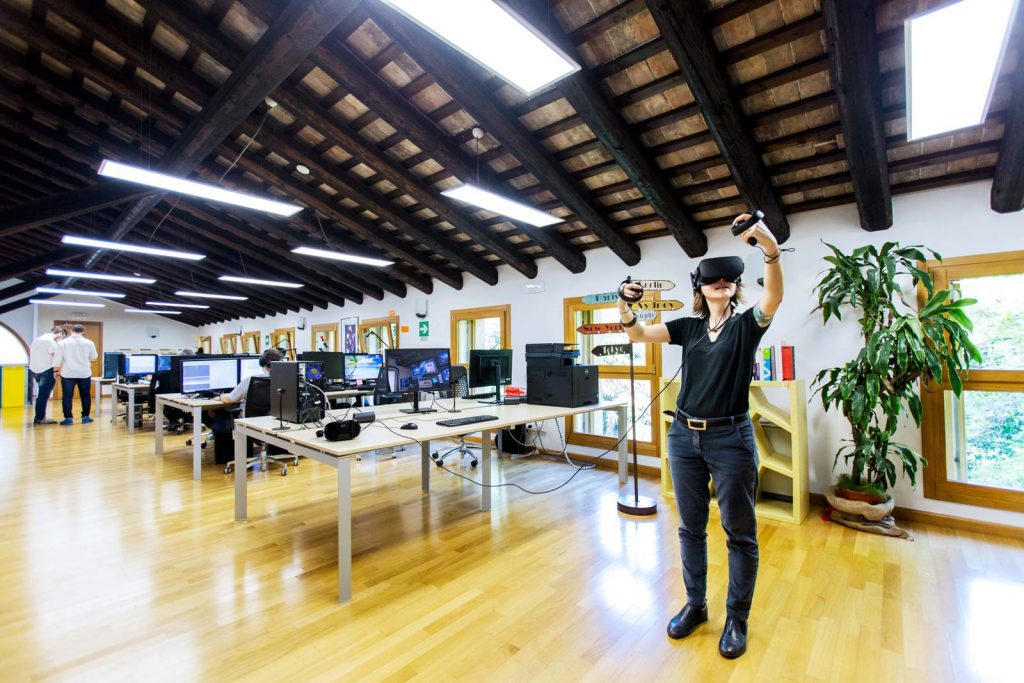
If I have to mention some ambitious projects, I would point to those related to the use of Machine Learning and the development of software capable of “learning”—loosely and somewhat improperly referred to as “Artificial Intelligence.” Going into detail, for a major global train manufacturer, within a project to build autonomous trains, we are contributing to the development of a subsystem that uses LIDAR—a remote sensing technology that determines the distance of an object or surface using laser pulses—to recognize the surrounding landscape and detect ongoing changes (for example, the growth of a bush or the beginning of a landslide), allowing trains to alert maintenance teams. In a second upcoming project, we will develop the Artificial Intelligence needed to make large cranes autonomous. Imagine a train loaded with steel bars, plates or coils that needs to be unloaded in a large yard. The crane must independently recognize the type of material, identify the best gripping point, and unload the train without any human intervention, ensuring complete safety for people. There are also other simpler projects. For example, an Artificial Intelligence system capable of predicting national and customer energy demand to allow an energy company to optimize its energy purchases. Or a system that, using data from the customers of a large service company, can predict which customers are considering—or are likely to consider in the near future—switching provider and for what reasons. This creates a competitive advantage for the company, which can then launch targeted retention campaigns.
How do you imagine Interlogica in five years?
If I close my eyes, I see us having grown significantly in terms of size, present in multiple countries, and engaged in increasingly ambitious and interesting projects. The world is changing rapidly before our eyes, and I firmly believe that investing in building an ecosystem that stimulates human intelligence is the best possible choice. We are strongly committed to becoming more and more the ideal partner for the strategic transformation of companies and also to “embrace the challenge of creating a world in which humans and technology bring out the best in each other,” as clearly stated in our Purpose.